Three Common Production Methods for Large-Diameter Straight Seam Steel Pipes
Large-diameter steel pipes are typically made of medium- to high-carbon alloy steels. After quenching, a portion of the undercooled austenite may remain untransformed into martensite, becoming residual austenite in the final product.
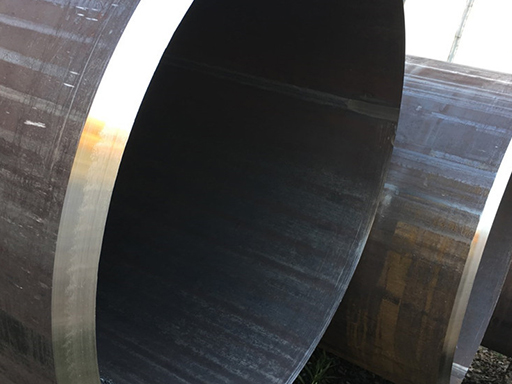
Three Common Production Methods for Large-Diameter Straight Seam Steel Pipes
Production and Quality Control of Large-Diameter Steel Pipes ( X60 pipeline )
Large-diameter steel pipes are typically made of medium- to high-carbon alloy steels. After quenching, a portion of the undercooled austenite may remain untransformed into martensite, becoming residual austenite in the final product. This residual austenite can negatively impact performance. Further cooling below 0°C promotes the transformation of residual austenite into martensite, effectively extending the quenching process. However, the superposition of quenching stresses at room temperature and sub-zero temperatures can exceed the material’s strength, leading to cold treatment cracks.
Preventive Measures:
● After quenching and before cold treatment, immerse the pipe in boiling water for 30–60 minutes. This reduces quenching stress by 15–25% and stabilizes residual austenite.
● Perform conventional cold treatment at -60°C or deep cryogenic treatment at -120°C. Lower temperatures increase the transformation of residual austenite to martensite, but 2–5% residual austenite typically remains. This retained austenite acts as a stress buffer due to its soft and ductile nature, absorbing energy from martensitic expansion and mitigating phase transformation stresses.
Three Common Production Methods for Large-Diameter Welded Pipes
1. Direct Forming and Welding:
● Process: Plate/coil → forming → welding → sizing.
● Features: Short production cycle, minimal steps, lower precision.
2. DOM (Drawn Over Mandrel) ERW Pipes:
● Process: Plate/coil → forming → welding → sizing → cold drawing/rolling (with or without mandrel).
● Features: Dispersed steps, long cycle, high dimensional accuracy, superior surface finish, and enhanced mechanical properties.
3. Continuous Cold Reduction:
● Process: Plate/coil → forming → welding → continuous cold reduction.
● Features: Compact process, rapid specification changes, ideal for small-diameter, thin-walled pipes.
Quality Control in Large-Diameter Welded Pipe Production
Piercing Temperature: Typically ~1200°C (lower for high-carbon/alloy steels).
Oxide Scale Management: Minimize oxide formation during heating, especially critical for extrusion tool life and surface quality.
Heating Process:
● Use rotary hearth furnaces for uniform heating to avoid cracks, folds, or eccentricity.
● Control piercing temperature to ensure optimal forming conditions.
Key Equipment:
● Heating furnaces: Preheat billets to forming temperatures.
● Reheating furnaces: Maintain temperature during processing.